
Accusing A Witch!
Yes, there were guidelines.

Who could accuse a witch and how would one go about it?
Well, as evil and delulu as the Malleus Maleficarum was, they actually did treat accusations incredibly seriously…
Methods of “initiating a process on behalf of the faith against witches” under Canon Law:
1) If someone accuses a person before a judge of the crime of heresy, offering to prove it, they shall be subject to the penalty of talion if he fails to prove it. That is, retribution (sometimes translated as ‘an eye for an eye’) — the accuser suffers the same harm they sought to inflict if they fail!
2) The accuser is not willing to prove it – this seems acceptable, because they may present information out of zeal, or they may face excommunication if they do not lay out the information (a vicar may force them to do it), or a secular judge may threaten temporal punishment. Basically, the accuser may be reluctantly forced into it by an authority, so the onus of proof should not be upon them, and thus is an informer as opposed to an accuser.
3) An inquisition! There may be a general report of witchcraft in a town or place, so a judge must investigate.
The process should be started by affixing a general citation to the walls of the parish church or town hall. There was even specific wording suggested.
A notary and two honest persons should be present during the examination of any witnesses. Ideally, at least one should be of the clergy, for the accusation is of a grave crime and these people are there to ensure no error is committed in imposing a severe punishment upon the guilty.
A public official is to faithfully write down the depositions. Again, there was specific wording prescribed for the start of the witness statement/s.
The number of witnesses if method 2) is used (via an informer), two witnesses “would seem to be enough to satisfy the rigour of the law” but given the “heinousness of the crime” this does not seem to be enough. In Canon Law, the oath of three (or more) good men is deemed sufficient.
But there is a caution that “the proof of an accusation ought to be clearer than daylight” and “no one is to be condemned on merely presumptive evidence.”
However, it was always under the judge’s discretion as each case may have differing factors. The judge was allowed to question witnesses several times under oath.
“Just as a heretic may give evidence against a heretic, so may a witch against a witch.”
To further protect against false accusations, the accused shall be questioned as to whether they have any mortal enemies who would accuse them out of hatred. If the accused witch then, without prior knowledge as to the identity of their accuser, name them then the reliability of that witness is thrown into doubt (but not entirely disqualified at once!).
Now, this was all as per one of the most evil books ever written, but in 1486 and in Germany. By the time the majority of witch trials occurred in England, it was a couple of hundred years later. Times had changed, people panicked and, as we’ve explored in previous posts, the religious and political environment was in turmoil. Oh, and people were starving.
So, I suspect a lot of the time this due diligence wasn’t adhered to quite as stringently as one would have hoped. The likes of Hopkins and Stearne seem to have self-appointed themselves in vainglory, so were quite probably drunk with power, for instance. Matthew Hopkins, it’s reckoned, managed to accuse around 300 people of witchcraft (100 of whom were executed)!
However, that being said, there were plenty of people in authority challenging the witch hunts.
In direct opposition to the methods employed by Matthew Hopkins, we had the likes of Reverend John Gaule, the vicar of Great Staughton, Huntingdonshire. This worthy man went so far as to publish a pamphlet titled Select Cases of Conscience touching Witches and Witchcrafts (1646). In his Sunday sermons, Gaule argued that the witch-finders were acting unreasonably, using torture, and were motivated by money.
But there were justices of the assizes asking questions too - charging fees and using torture were deemed unjust.
Sir John Holt, the chief justice of the court of King’s Bench, himself played a role in the demise of witch trials. At the Surrey Assizes in 1702, he prosecuted Richard Hathaway for “pretending Bewitching” (made false allegations).
Even the general populace eventually grew sceptical as their purses were hit by the high costs involved. Eurgh, humans!?
Anyway, my point is, that not everyone was witch-hunt crazy - there were always voices of reason. But there were also those who were scared and/or malicious, who clearly made accusations willingly.
And it may have been trickier than we thought to make an accusation, which explains the lower than expected estimate of 2,000 people tried for witchcraft in England throughout the period of persecution. I mean, that’s still 2,000 too many, obviously. Just maybe fewer than I thought there would be. Compare this with Scotland who executed around 4,000, and one pauses for thought.
It does make me wonder how many were accused without going to trial.

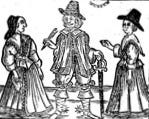
Now, this gets interesting. For we have the records left by the astrologer-doctor Reverend Richard Napier, in Buckinghamshire (1594-1634) (pictured above). Yes, he was the rector of Great Linford but also an astrologer and medical practitioner - everyone has to have a hobby, I guess. However, this made him the ideal person to initially seek advice from.
In his daily records, we discover that many of his clients came to him with concerns of “having been bewitched by a neighbour”. Now, these queries only made up 2.5% of his copious notes. But between 1597 and 1634, Napier recorded 1,714 witchcraft accusations! Most of these accusers and the accused were women, but then they were involved in female oriented work environments, so don’t read too much into that. But crumbs, that’s almost as many as those tried in all of England!! Clearly, he guided them back to reason in the majority of these cases. Also, Rich was never bored, I’d wager - busy guy! And get a load of that outfit!
In conclusion, I think a lot of people were suspicious of their friends, family and/or neighbours (paranoia is easy to instil). BUT maybe most managed to be reasoned out of their doubts, or just feared the consequences of being wrong.
Always in love and light,
TL
Blessed be.