

Going Potty for Medieval
How people went to the toilet

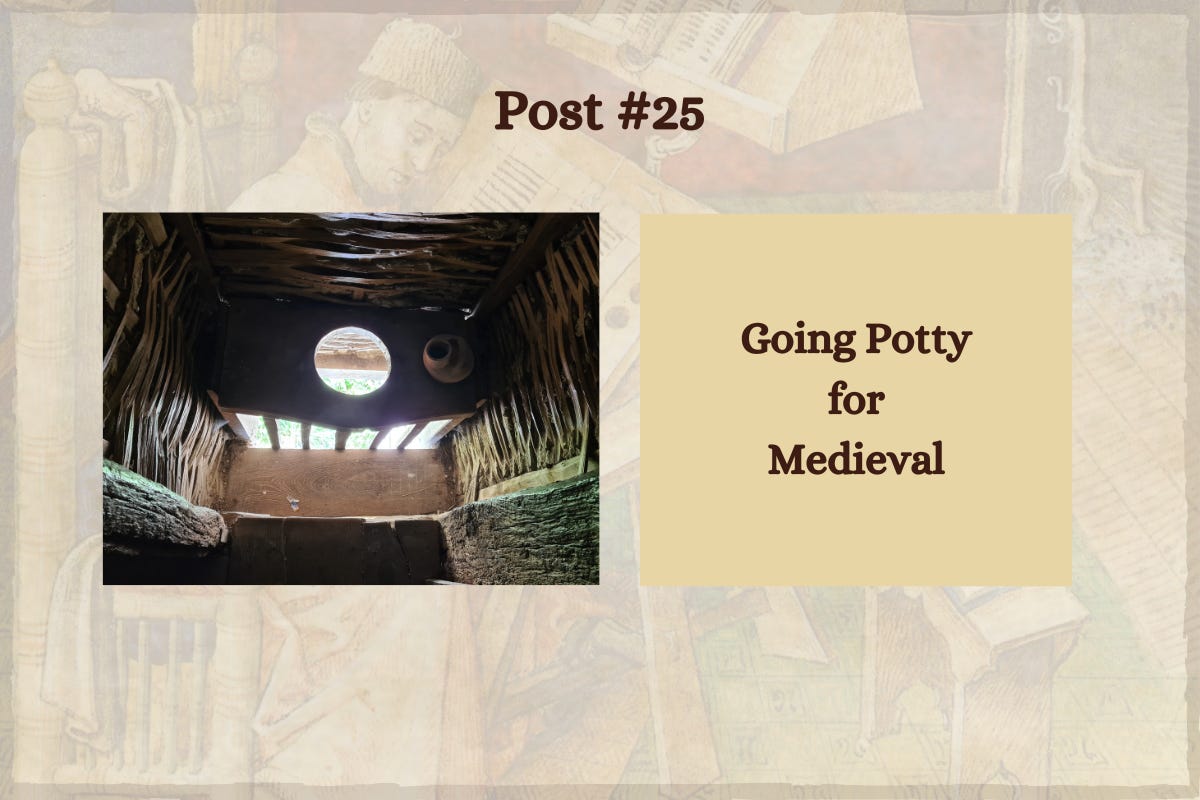
Whilst chatting to various folk about medieval life, a frequent question which crops up is, “How did they go to the toilet?”
And it’s a sensible question. To us modern folk, the thought of not having a flushing loo and quilted toilet paper is, quite frankly, horrendous. Yet these luxuries are really very recent.
OK, so the answer, like most other things, depends very much on which social order you belonged to.
The Rich
In the manor house (where the lord lived), the garderobe / privy was located within or adjacent to the wardrobe. Yes, this was the toilet. A glorified hole, with probably a plank of wood atop it (also with a hole in). Some jutted out of the house wall on a platform. But they all had to lead somewhere; chutes took the...err..waste down to a cesspit or moat. Both of these would need to be cleared out every so often – what a lovely job that must’ve been!?
NB Moated houses were decreasing in popularity, partly because of the associated stench and it attracted nasties like bugs and rats. So, not many manor houses were moated in the 15th century.
(photo in header image is a privy in a farmhouse at Weald & Downland Museum)
Straw or rags were used for...wiping. Sometimes, a damp sponge on a stick. A window was happily situated to help alleviate the odour. Bars were in situ to stop intruders entering via the chutes.
Chamber pots were also used, by the way.
The Poor
Peasants had a ‘night soil bucket’. Poo in one bucket, pee in a different pot. These would be disposed of in separate cesspits/midden heaps. Each had a different use.
Out & About
But what if you’re caught short in public? Well, there were ‘common privies’ (public toilets) in the cities. Also known as ‘common jakes’, ‘pissyngholes’ or ‘house of easement’. There were thirteen of these in London, one of which apparently seated 84 people! All poo together!?
Public latrines were usually situated next to or near the main waterways, so pipes could carry the waste directly into those watercourses. Some were directly on bridges. Lovely!?
If visiting an inn or even a tavern, there were quite possibly barrels with planks over for one’s use. These barrels would then be taken to the nearest cesspit to be emptied. But if staying overnight, there should also be a chamber pot.
By the way, if someone wishes to go to the loo/toilet, “going to siege” was a euphemism for that.
Collecting the Waste
When pipes didn’t carry droppings to water treatment works, how did they get rid of all that shit?
Gong farmers would collect the waste from cesspits and moats (at night). They may be paid as much as 2s per tonne of waste.
The excrement was useful fertiliser. But the urine was used for washing clothes, quenching steel, dyeing wool and in the tanneries to remove hairs from leather.
Having said all this, there still seems to have been folk who poured their liquid waste from their windows into the street gulleys whilst crying out, “Garde a l'eau!” (‘Watch out for the water’).
Look, I know this was all a bit unpleasant, but readers do worry when characters never relieve themselves, so it’s important to know how/where they can go.

For more fun-filled facts, do consider purchasing my book, An Author’s Research Notes on Medieval England.
Always in love and light,
TL