
Medieval Christmastide
The Twelve Days of Christmas

Welcome. Pull up a festive pew.
Back in the Middle Ages, when England was Catholic, folk celebrated Christmas for twelve days. It’s not just a fun song - who knew?! Twelve days off work for partying. Well, unless you had to keep the house clean and/or fed, or were tending livestock.
The pagans had celebrated winter solstice around 13th December (and still do) - the shortest day of the year. And it’s one I’m always thankful for. The sun slowly starts to return from that point. Ancient Romans celebrated this as Saturnalia.
The Christians maybe kinda overwrote that date with St Lucy’s Day, and the ensuing Christmastide. Sceptics could deduce that the belief of ‘decorating one’s house before Christmas Eve was unlucky’ was to stop folk decorating for winter solstice. I make no such insinuation, of course.
But I’m getting side-tracked. Let’s start at the beginning.
All the way back on 11th November, Catholics celebrated Martinmas - the saints day of St Martin of Tours. Roasted beef may have been the dish of the day. This was the time of year when all the harvests had been brought in, (*caution vegans & vegetarians*) livestock was slaughtered, and meat was salted / preserved to keep it over winter. They even called it Martlemas Beef.
However, goose was actually a traditional meat for the day of Martinmas. The story goes that St Martin of Tours was trying to evade being made a bishop, so hid in a pen of geese. The birds squawked and gave the poor chap away, and he became a (very good) bishop anyway.
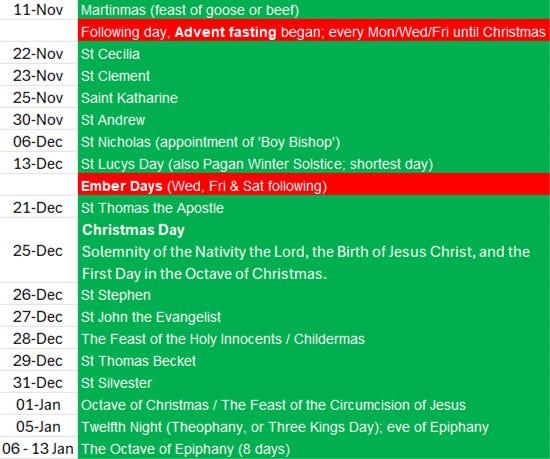
I mention all this as it’s a pivotal day. For the devout, such as the monks and nuns, the Advent Fasting began the day of Martinmas - every Monday, Wednesday and Friday until Christmas Day.
In case that wasn’t enough, there were three Ember Days, the Wednesday, Friday and Saturday following St Lucy’s Day (13th December). These were hard fasts - no food at all before nones (or 3pm). Depending on the time within the medieval era, no ‘flesh’, dairy or eggs were to be consumed. Their light supper may be fish/vegetables/pottage. They were also a days of penance and prayer.
Ember Days were also observed throughout the year, following Ash Wednesday, Whitsuntide and the Exaltation of the Cross.
Some other saints days may also be celebrated after this. Not everyone observed every saints day, but they did in the monasteries. I’ll list them out in a sec.
DAYS
We finally arrive at Christmas Day, and thus begin Christmastide:
Christmas Day (25th December) until the evening of Twelfth Night (5th January)
Christmas Day
Everyone was expected to attend Mass this day. But it was also a quarter day - when rent payments were due; boo!
St Stephens Day
Was then the day of gifting to one’s inferiors. Farm workers and/or general poor of the estate could be given a “piggie” - a small clay pot, usually with a gift of coins inside. One would have to smash the pot to get to the money.
Childermas
On the 28th December, The Feast of the Holy Innocents aka Childermas, a ‘Boy Bishop’ would be appointed for the season. He may have been gifted food and/or money, and had ceremonial roles throughout Christmastide.
Epiphany
The Eve of Epiphany was 5th January, and all the decorations had to be taken down (again to avoid bad luck). Everyone was expected to attend Mass for that too, to close down Christmastide.
DECORATIONS
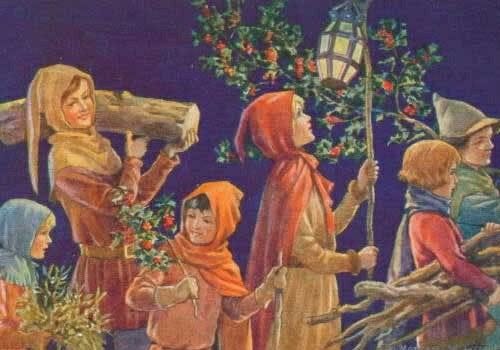
Folk would go and gather boughs (branches) on Christmas Eve. Thanks to another song, we’re maybe most familiar with the boughs of holly (falala). Yes, they did use these.
Rosemary, mistletoe, holly and ivy would also adorn houses and churches.
Now, evergreens have long been a symbol of hope in the darkest part of winter. Many cultures have used them as a symbol of life over death / sun’s return etc. Ancient Egyptians, Greeks, Romans, Scandinavians et al have done so.
Pagans had utilised evergreens to variously ward off evil and bring good fortune. e.g. Mistletoe was a beacon of fertility and the spiky holly and ivy would ward off negative spirits such as goblins.
Under Catholic rule, the holly wreaths became a symbol of the crown of thorns worn by Christ. The ivy was to remind Christians to cling to God for support and guidance. Yet the old beliefs of protection and warding off evil remained.
The Yule Log would also be lit on Christmas Eve. This too had pagan origins, symbolising the return of the sun. The word yule tracks back through the Old English, geol, to the Old Norse jól - the midwinter solstice festival.
But getting back to the log. In England, it was probably oak wood. And it was lit from the charred remnants of the previous year’s yule log. The flames would then be kept for the next twelve days.
FOOD
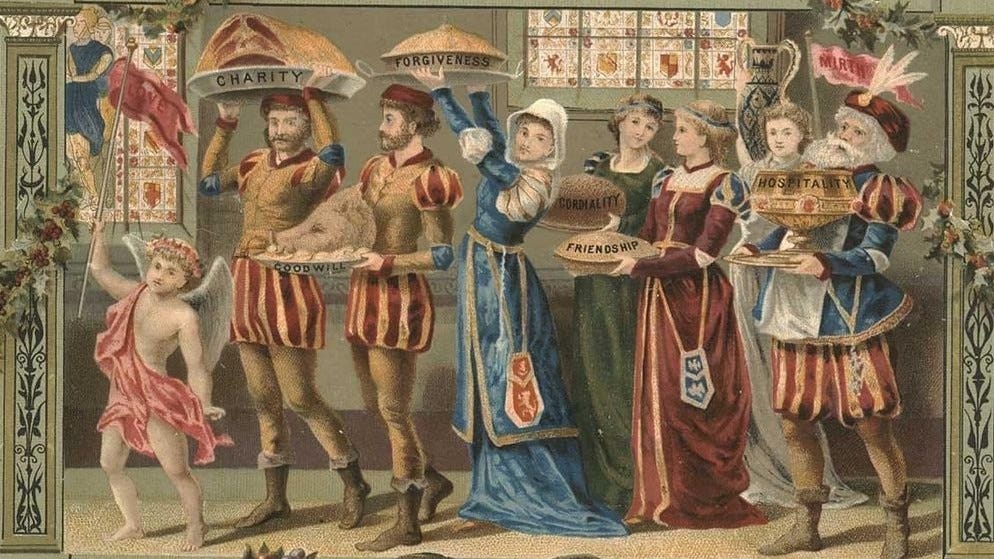
No matter who you were, at Christmas, you would eat as well as you possibly could. Obviously, this varied according to budget.
But the wealthy may have had a hog’s head - remember there was a carol about that? Or a great pye, which I think sounds yummy, and is probably the forerunner to our modern mince pies (which no longer contain mince meat). This was like a huge pork pie, but filled with chicken, minded beef, pigeon, wild duck and/or saddle of hare / rabbit, cooked with prunes, dates and spices.
Feasts and drinking would encompass all. The posh folk would be expected to host banquets/feasts and to attend in return.
And don’t forget the wassailing! This event harkens back to before the Middle Ages. If one lived in a cider-producing region, a group of folk would parade around the orchard at dusk, signing and clamouring to chase away those evil spirits - they really were rife at that time of year! Cider was poured on the roots of the trees. And the drink of wassail was popular in most places, I believe - a hot, spiced, cider.
There was a form of wassailing which involved going door-to-door with a wassail bowl, singing songs. Each householder would add wassail to said bowl, in exchange for blessings for the year. Presumably, this took place where there were no orchards.
Sport and games were played, including gambling. Pantomimes and plays were performed and enjoyed. Dancing and singing, and all sorts of merriment ensued.
The revels could become really quite raucous. The nightwatchmen would increase in number. However, there are rumours they were paid in alcohol and would become drunk themselves, so may not have been terribly effective. Well, it was Christmas!! LOL
Look, there’s an awful lot of information here. But to fully feel what a medieval Christmas was like, I may have a novelette up my sleeve for your immersive enjoyment. Watch this space! ;-)
Always in love and light,
TL