
Samhain
What is it? And how do you pronounce it?

Greetings!
I felt bad, having written a whole post about medieval Halloween last week, and not properly discussing Samhain. For that is the festival which resonates more deeply with me. And hey, it’s my favourite time of the year, and I can do two posts about it.
I’d just like to say I’m not an expert. There are people far more qualified to detail this. This post is information from what I’ve learned and to honour this celebration.
Let’s start with how to pronounce it. Now, this gets people’s backs up really quickly, so I’m just going to list the different options. *SPOILER* It is never ‘sam-hayne’, despite it’s spelling. The reason for this is that it is a Gaelic word which means ‘summer’s end’ (probably - may stem back further to ‘summer fun’).
That being said, it is a festival deeply rooted in Ireland, and they are rightly protective, so if we’re going to be strict, theirs is the correct pronunciation. However, accents and dialects vary even there, so it’s tricky.
OK, the closest I’m going to get is to say these are the generally accepted modern pronunciations.
‘SOW-ihn’ in Ireland - sow rhymes with cow, plus a slightly elongated ‘in’
In various areas of Ireland, it may be more ‘soun’.
‘SAH-vin’ in Scotland - sah rhymes with far
(unless you choose the Scottish Oidhche Shamhna version)
‘SOW-een’ in Wales
(unless you go full Welsh with Nos Galan Gaeaf)
‘SOW-win’ in England
But however you say it, Samhain is the festival which celebrates the end of summer/harvest and the start of winter.
It originated over 2,000 years ago. It is Celtic Pagan. It is midway between the autumn equinox and winter solstice. It marks the Celtic New Year.
And this is later echoed in the medieval Halloween I discussed in my previous post - the end of the agricultural year.
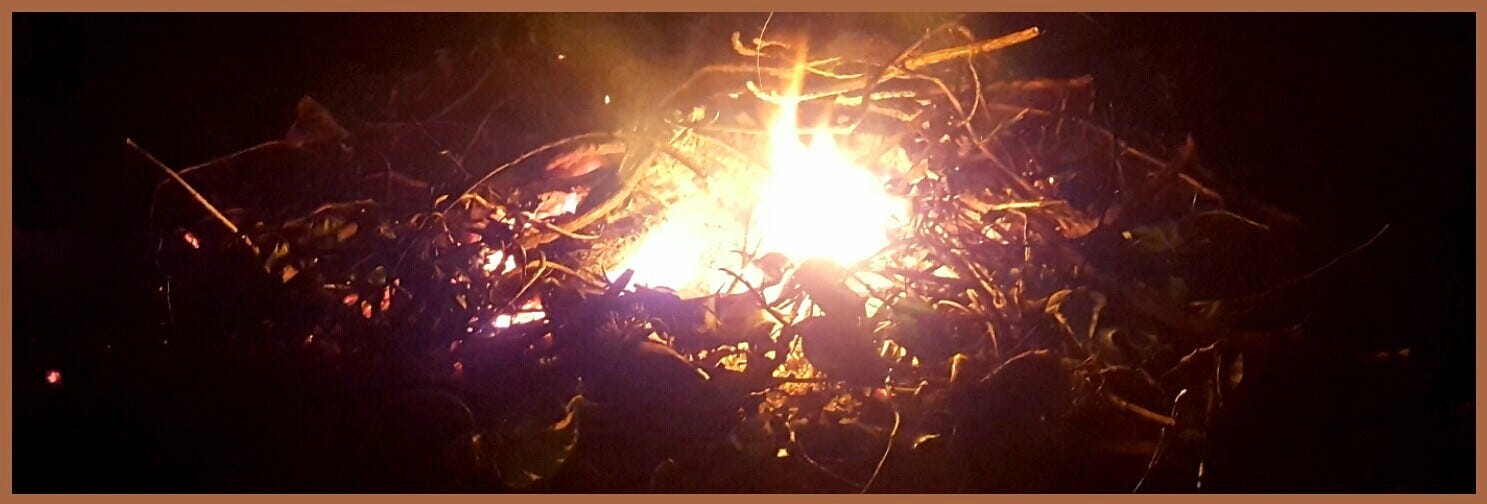
Bonfires have always very much been part of the festival. Again, in my other post, we explored the literal bone fire origins of these (which also had tree branches, btw). And that ceremony of extinguishing the hearth fires in the house and relighting it from the ceremonial bonfire stems from the Celtic Samhain - they may have had druids do this, originally.
There is a thought that even this can be traced back to County Meath at the Hill of Ward (Tlachtga), Ireland. It is believed that an enormous fire was lit there and neighbouring fires would then be lit from it. How cool is that?
Then, as now, it was acknowledged that the veil between worlds became thinnest at this time of year. All those vital crops now stored for winter had to be protected from any evil spirits who then roamed the land. These could either be fae or spirits of the dead i.e. ghosts. Beware the Sidhe (pronounced ‘shee’) - a real thing!
Originally, it seems Sidhe referred to the mounds guarding entrances to the otherworld, but came to mean the fairy folk who dwelled therein. They are complex folk and possibly need a whole post on their own. Suffice it to say there is a Daoi-Sith in my books Love Bites & Love Bites Harder (The Darkness & Light Duology), and he is not nice! He stems from the Scottish dark elves, who in turn possibly have a relation to the good Irish Daoine Sidhe.
Anyway, the bonfires were one way of luring these dangerous spirits away. Masks and disguises were also worn to frighten them off. From the 16th century, this seems to have been called guising up in Scotland.
And before people started carving up precious vegetables, it’s thought that some form of candle/rushlight was lit inside skulls and hung from trees. I’m still not posting a picture of a carved turnip or swede - they are too scary; just horrendous! :-O
This all sounds macabre but it was a joyous time. Celebrating (hopefully) a successful harvest season and reminding themselves of the great cycle of life. All beginnings have an end and every end marks a beginning. Despite the encroaching darkness, the light will return again. Therefore, feasts and revelry were very much part of the festival.
Oh, and if you enjoy a toffee (/candy) apple this time of year, you’ll be happy to know that apples have long been associated with these festivals. These sweet orbs look like they were around in Neolithic Britain, but are usually associated with the Ancient Romans bringing them to our shores.
Samhain blessings to you / Happy Halloween!
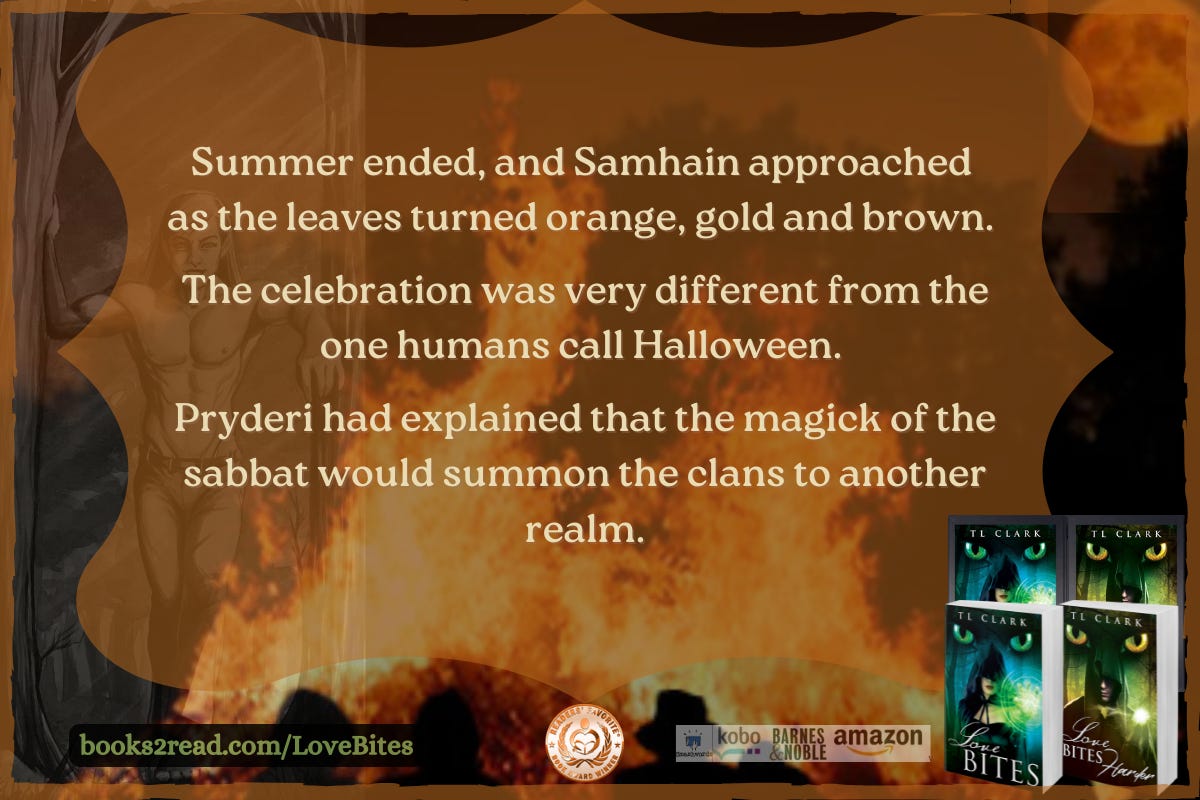
My books with the most pagan-like affinity are my Love Bites ones.
Love Bites & Love Bites Harder form the Darkness & Light Duology -
a m/f fated mates romantasy.
Love Bites MORE is the stand-alone follow-up about m/m/m fated mates.
All include elinefae, witches, fae and dragons.
Always in love and light,
TL