
The Interregnum
When and what was it?

Directions: Carry on straight out of medieval England, past the Tudors, next right into the Stuarts (pt. 1) then left to the Interregnum. If you get to the Stuarts (pt. 2), you’ve gone too far - turn back before you run into the Georgians!
Yes, it was a weird ‘in between’ sort of a time. Clue’s in the name, really; interregnum is Latin, and translates to ‘between reigns’. It alludes to an interval between two reigns (monarchs/rulers).
And none of the English interregnum was good, as far as I can see. I’m hoping to discover something nice as I continue my research. I’ll be sure to share anything good as I proceed.
But let’s start with the basics. I’ll put it into better context of the era:
So, we had the medieval era which ended around 1485
Which gave us the Tudors: 1485 – 1603
Then the Stuarts: 1603 – 1714
Within the Stuarts, we paused for the Interregnum: (1649–1660)
After the Stuarts made their comeback, we went into the Hanoverian Era: 1714 – 1901 (where we find the Georgians, incl. the Regency)
In terms of my writing, I’ve gone from the very tail end of the medieval period to this, so some 165 years on. And a lot has happened! Understandably. If I wrote about 165 years ago from today, the book would be set in 1861.
Monarchs
Maybe it’s easier to see who was on the throne in the 17th century?
Elizabeth I: 1558 – 1603
(the last Tudor monarch)
James I (aka James VI of Scotland): 1603 – 1625
(the reign of the Stuarts begins)
Charles I (beheaded): 1625 – 1649 (son of James I)
Interregnum (no monarch/republic): 1649 – 1660
Within that: Protectorate (led by Cromwell): 1653 – 1658
Richard Cromwell (Oliver’s son) took over but was defeated in 1659
Charles II (The Restoration) (King of Scotland from 1651): 1660 – 1685
When he was crowned in 1660, he became the King of England, Scotland and Ireland.
James II (James VII of Scotland): 1685 – 1688
Queen Mary II and King William III (joint): 1688 – 1694
King William III (aka William of Orange) (on his own after Queen Mary’s death): 1694 – 1702
Queen Anne: 1702 - 1714
(here endeth the Stuarts)
NB I’ve not gone into the Scottish list of Stuart monarchs here - I didn’t want to cause confusion. But yes, their list is a little different. This is because the countries were separate still.
In 1603, King James VI of Scotland also became King of England and King of Ireland. This was the Union of the Crowns. He titled himself King of Great Britain. But it was a personal (or dynastic) union only. For each crown maintained its own separate state; England, Ireland and Scotland merely shared a monarch who directed domestic and foreign policies for them. I might do a separate post on England vs GB later.
btw If you’ve not seen the Horrible Histories song about Charles II, do yourself a favour and search for it. Makes me giggle.
But what do we mean by the Interregnum?
It gets a little bit complicated. But effectively, it was the time when England had no monarch (no king, no king, lalala). It lasted from the execution of Charles I until the restoration of the monarchy, which gives us those dates of 1649–1660.
On 6th December 1648, Colonel Thomas Pride had his soldiers purge the House of Commons of folk who refused to back the plan to try King Charles I for high treason. This is known as the Rump Parliament / Long Parliament.
Between 1649 and 1653, England was ruled by the Commonwealth. A time of strict Puritan-led reforms.
On 4th July 1653, Barebone's Parliament (the Little Parliament), was created. It was a last-ditch effort to stabilise the political situation.
Fun fact: Barebone’s first name was Praise-God; guess which side he was on!
However, obviously, there was a lot of fighting an manoeuvring. It was a bit of a disaster, quite frankly. So, in stepped Oliver Cromwell. He became Lord Protector from December 1653 until his death in September 1658. This period is ‘The Protectorate’.
Got that? The Protectorate was a period within the interregnum.
This all happened after The English Civil War - 1639-1651.
Wars of the Three Kingdoms — Royalists & Confederates vs Parliamentarians & Scottish Covenanters: Parliamentarian victory
This was made up of several wars, but let’s not get bogged down with details on those at this stage.
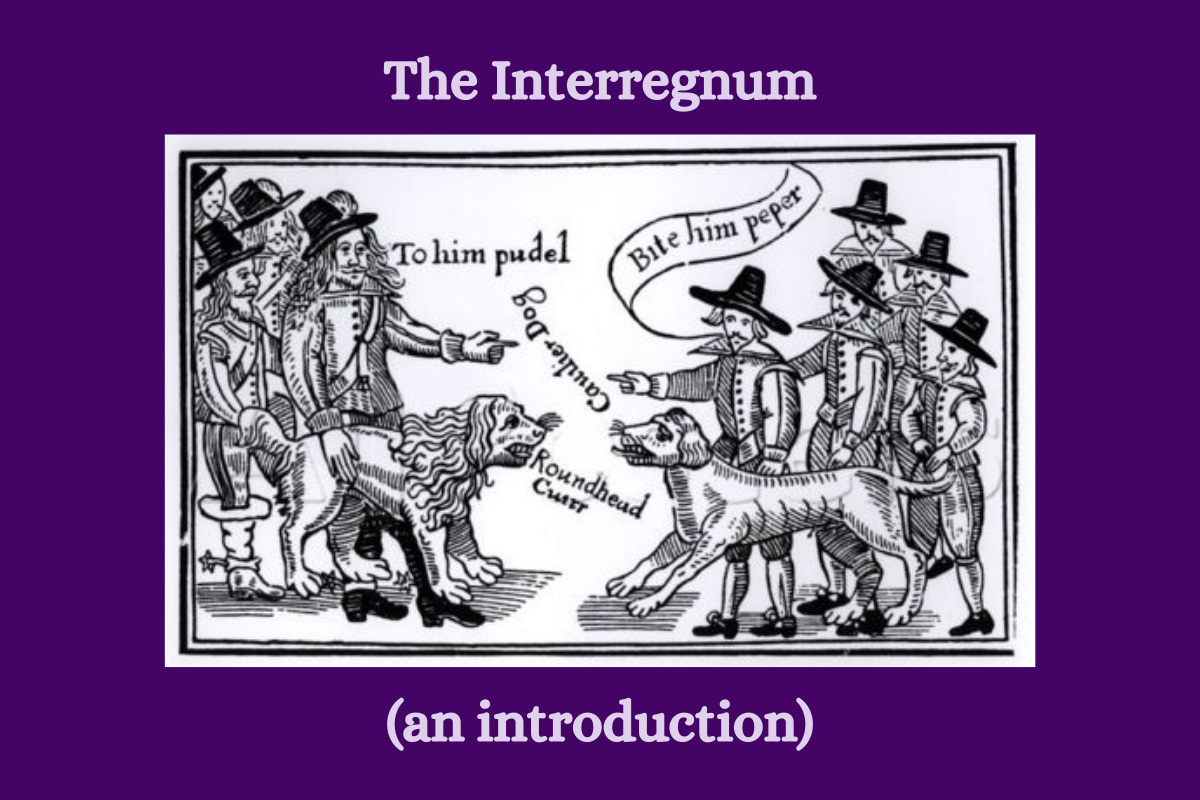
This is where we get the idea of the roundheads (supporters of Parliament) and the cavaliers (the royalists / supporters of the King).
Key Events
Oh, things were messy! I find it easier to look at some general key points at whichever era I look at. But phew, there was a lot going on.
Christmas was banned in England in June 1647 by Parliament (as part of a larger effort to abolish any kind of fun celebrations, basically). We didn’t get Christmas back until the new king in 1662. Boo!
But what else was happening?
· 1562 - Witchcraft made a capital offense in England
· 1582 - Gregorian calendar introduced
· 1587 - Famine and possible typhus epidemic
· 1593 – Plague
· 1597 – The chap later known as King James I wrote Dæmonologie (probably inspired by the Malleus Maleficarum, which itself was published around 1486 and is the vilest thing I’ve ever had the displeasure of reading).
· 1603 - King James I succeeded to the English crown (King James VI of Scotland) (Protestant)
· 1605 – The Gunpowder Plot (the failed, Catholic plan to blow up the Houses of Parliament when King James was in it). And why we still have Guy Fawkes Night.
· 1607 – Shakespeare: Macbeth first performed
· 1607 - Flight of the Earls: Hugh O’Neill (Earl of Tyrone) and Rory O’Donnell (Earl of Tyrconnell) had their authority restricted by the new lord deputy, Arthur Chichester, in 1605. Fearing arrest, the two fled with their families to the continent. This marked the end of the power of Ireland’s Gaelic aristocracy. Tsk!
· 1611 - The King James translation of the Bible is published (the first ever English version as opposed to Latin)
· 1612 – Pendle Witch Trials (just weeks after Northamptonshire trials, where dunking is thought to have first been used)
· 1616 – Shakespeare died 23rd April
· 1620 - The Pilgrims land at Plymouth Rock, Massachusetts, aboard the Mayflower (The Pilgrim Fathers) (hears chants of, “USA, USA!” - not that it was the USA yet; that happened in 1776)
· 1623 - Famine strikes areas of England, Ireland and Scotland - many starved (probably England’s last peacetime famine)
· 1625– Plague
· 1629 - Charles I dissolves parliament and begins 11 years of personal rule; no politicians!
· 1637 - New Scottish prayer book causes a riot in Edinburgh
· 1640 - In April, 'Short Parliament' opens at Westminster - Desperate for money to fight the Scots, Charles I was forced to summon a new parliament (which was then dissolved after a month)
· 1640- In November, 'Long Parliament' opens at Westminster, as the Scottish took hold of Northern England. This one lasted until 1660 as they refused to dissolve.
· 1641 - Rebellion breaks out in Ireland
· 1642 - Charles I tries to arrest five leading members of parliament
· 1642 - Civil War begins
· 1644 - Christmas is made illegal!
· 1645 – Chelmsford Witch Trials: Stearne & Hopkins involved (enter the witch finders!)
· 1647 - Parliament had won the civil war in England, Scotland and Ireland. King Charles I was held in captivity at Hampton Court. And The Church of England had been abolished and replaced by a Presbyterian system.
· 1649 - Charles I is executed at Whitehall, London
· 1652 - Penenden Heath witch trials, Kent (20 hanged)
· 1653 - Oliver Cromwell becomes Lord Protector (Puritan)
· 1658 - Oliver Cromwell dies and is succeeded by his son, Richard
· 1660 - Charles II is restored to the throne (Anglican) = The Restoration
· 1665 - Great Plague of London begins
· 1666 - Great Fire of London destroys two-thirds of the city
I will be poking around lots of this in more depth as I go. But this is a high-level overview so you can see what was happening.
It was the worst of times, it was the…worst of times.
Religious and political dissent. Famine/starvation. Illness.
England (and its neighbours) was a powder keg! See what I did there? ;)
I did warn you it was tumultuous !
Always in love and light,
TL